Crypto Options
Crypto Options Selling Ideas for November 7, 2025 – Cash-Secured Puts & Covered Calls
| 7 seen
Welcome to the first weekly newsletter from Terramatris Research, where we highlight potential trade candidates discovered by our in-house options scanner at scanner.terramatris.eu.
Each week, our screening engine evaluates crypto options across BTC, ETH, and selected altcoins to identify premium-selling setups with favorable risk-to-reward and a statistically high chance of expiring worthless.
In this inaugural edition, we focus on simple option-selling strategies:
Cash-secured puts – for traders comfortable owning the underlying at a discount.
Covered calls – for those already holding the asset and seeking to earn additional yield.
We do not recommend selling naked call options under any circumstances, and we strongly discourage the use of significant leverage. If you choose to apply leverage, keep it minimal — think 1.1 ×, not 5 ×. The objective here is steady, compounding premium income, not gambling on volatility spikes.
Without further ado, here are this week’s trade ideas our scanner flagged as potentially profitable, high-probability candidates for expiration without value.
Trade Recommendations – Week of November 7, 2025
This week’s Terramatris Options Scanner identified several high-probability premium-selling setups with attractive implied volatility and strong probabilities of expiring worthless.
We focus only on short-premium strategies — selling puts and covered calls — that align with our conservative, income-oriented approach. All probabilities are derived from real-time Deribit option data; values such as delta, IV, and mark price are included for reference.
Cash secured puts

All listed trades show probabilities of expiring OTM above 75 %, indicating favorable odds for option sellers.
BTC’s short-dated puts offer tighter spreads and lower margin requirements, while ETH continues to price in elevated volatility, rewarding premium collectors who manage risk carefully.
We recommend sticking with cash-secured puts and covered calls, avoiding naked positions. Use small size relative to total capital — think 1–5 % risk per leg, no leverage, and be prepared to take assignment if prices drop.
Covered calls
All the listed positions have probabilities of expiring out-of-the-money above 80 %, making them strong candidates for covered-call premium collection rather than naked call sales.

ETH remains the richer volatility target, offering better call-selling yields.
BTC premiums are lower in relative terms but stable and suitable for conservative covered-call exposure.
All trades carry high OTM probabilities (> 90 % on the top picks).
The focus remains on covered calls only — avoid naked call exposure, especially with IV above 70 %.
As always, use small allocation per leg (≈ 5 % of portfolio) and avoid leverage.
Next week, we’ll review the outcomes of these trades and, if needed, adjust the parameters of our options scanner to better align with evolving market volatility.
Never miss an update! Get weekly insights delivered to your inbox—subscribe to the Crypto Options newsletter
How to Repair a Deep-in-the-Money Covered Call in Crypto
| 37 seen
Covered calls are among the most reliable tools for extracting yield in volatile markets. Still, when prices fall sharply, even disciplined positions face pressure. The decision then shifts from profit maximization to risk control and capital efficiency.
In this article, we’ll walk through practical ways to repair a broken covered call, especially when the underlying asset has crashed and the position is deep in the money.
At Terramatris, we primarily trade crypto options, so the examples focus on assets like Ethereum — but the same principles apply to traditional stock covered calls as well.
1. Rolling Down the Call
When the underlying declines, the short call’s value drops. Buying it back and reselling at a lower strike increases income but sacrifices potential upside if prices recover. It’s a quick income fix, not a long-term solution.
2. Ratio Rolling (Adding Lower Calls)
Selling an additional lower strike call can speed up premium recovery but doubles exposure if the market reverses. It’s a tactic that rewards precision timing and disciplined risk sizing.
3. Closing and Re-Entering via Short Puts
Closing the covered call and pivoting to short puts allows traders to maintain premium flow while resetting exposure lower. It’s often cleaner when volatility remains high and directional conviction is low.
At Terramatris, we operate under a simple principle: Income first, precision later.
We’re comfortable selling aggressive calls below breakeven to maintain premium inflow — but only when risk/reward justifies it. Our breakeven on ETH is roughly $4,250, and we’re currently evaluating selling short-term calls with $3,600–$3,800 strikes while the market stabilizes around $3,200–$3,300.
This approach acknowledges near-term downside risk while extracting yield from elevated implied volatility. If the market recovers and ETH closes above the strike:
- Assignment at $3,600–$3,800 would effectively realize a controlled loss versus our original $4,250 entry.
- From there, we’d re-enter exposure via short puts, likely around $3,000–$3,200, collecting premium while positioning to rebuild ownership at a better cost basis.
This keeps the capital working without forcing early exits or reactive hedges.

When ETH plunged from ~$4,100 to $3,200, our 1 ETH covered call was deep underwater relative to the initial entry. Rather than panic-selling, we analyzed the probability curve:
- At-the-money IV was above 80%, creating strong short premium opportunities.
- Selling 1-week calls around $3,600–$3,700 would yield roughly $38–$56 per contract, translating to a 1–1.5% return on notional for a single week.
That’s sufficient to reduce the effective cost basis toward $4,200 even if price drifts sideways. If assigned, the follow-up short put cycle continues the yield chain without margin strain.
We’ve long maintained that leverage is a double-edged sword. It amplifies gains in quiet markets but can destroy capital during volatility spikes.
As the Terramatris portfolio grows, our objective is clear:
- Keep leverage lower, ideally under 1.2× net exposure.
- Prioritize liquidity and optionality over absolute yield.
- Let compounded option income grow the portfolio organically, rather than force size with borrowed capital.
Reducing leverage allows us to survive drawdowns intact — which, in option writing, is the real competitive edge.
Covered call “repair” isn’t about recovering every lost dollar — it’s about managing premium flow and risk posture intelligently. At Terramatris, we remain patient. We’re evaluating short calls between $3,500–$3,600, not rushing to sell. If assignment occurs, we’ll pivot to short puts near $3,000–$3,200 to re-establish long exposure with lower basis and continued yield.
In volatile markets, survival and steady premium accumulation matter more than speed.
Poor Man’s Crypto Hedge Fund: Earning Income from Dogecoin Options on Bybit
| 17 seen
After Bybit enabled options trading for Dogecoin (DOGE), we decided to include DOGE in the TerraM Multi-Asset Crypto Options Fund. Our favorite approach across assets remains consistent - selling put options to generate income and using that income to accumulate the underlying asset over time.
If assigned, we take delivery of the asset and sell covered calls. More often than not, we roll forward the position for a credit instead of letting the call get exercised, effectively compounding income while maintaining exposure.
On October 29, we opened our first DOGE position by selling:
- 1,000 DOGE put options
- Strike: $0.185
- Credit received: $0.019 per DOGE
- Expiry: October 31, 2025
By October 31, the strike was in the money, so we decided to take a proactive stance — rolling the position forward one week to the next expiry while lowering the strike price to $0.18 and earning an additional premium of $0.0058 per DOGE.
All collected premium is reinvested into spot DOGE, which is now part of our TerraM Multi-Asset fund.
- Spot DOGE holdings: 40 DOGE
- Short puts: 1,000 contracts (strike $0.18)
- Average buy price: $0.1895
- Break-even price: $0.1742
What happens next?
If, on expiry — November 7, 2025, DOGE remains above $0.18, our short put options will expire worthless, allowing us to keep the full premium and continue selling new weekly puts to generate consistent income.
If, however, DOGE trades below $0.18, we’ll evaluate two possible paths:
- Roll Out and Forward: Extend the position to a later expiry while keeping or slightly adjusting the strike price — ideally for an additional net credit, compounding the income stream.
- Take Assignment: Accept delivery, most likely in the form of a perpetual futures position, and transition to a covered call selling strategy to generate further yield.
This flexible approach allows us to adapt dynamically to market conditions while maintaining our primary goal — steady option income and strategic accumulation of DOGE within the TerraM Multi-Asset Crypto Options Fund.
After our first week with DOGE coin option we are looking at 3% income in 9 days
This marks the start of our “Poor Man’s Crypto Hedge Fund” series, where we’ll use DOGE as a fun and educational vehicle to demonstrate disciplined, option-based accumulation and yield generation in crypto markets.
As always, all DOGE income and positions are part of the TerraM Multi-Asset Crypto Options Fund, following the same risk-managed, income-compounding approach used with BTC, ETH, and SOL.
Introducing Terramatris SMA — Expanding Opportunities in Tailored Crypto Management
| 17 seen
At Terramatris, our journey has always been rooted in one clear goal — to grow capital through options trading. From day one, our focus has been on developing strategies that generate consistent, risk-adjusted returns in the ever-evolving crypto derivatives market.
In our early days, we briefly explored managing client portfolios through Separately Managed Accounts (SMAs). While that initiative never really took off at the time, it gave us valuable insights into the infrastructure, compliance, and communication needed to manage external capital effectively. Over the years, we instead found stronger growth in pooled asset management, developing scalable structures and robust strategies through our core vehicles — the TerraM Multi-Asset Crypto Options Fund, the Solana Covered Call Growth Fund, and our native TerraM token.
Now, with a mature foundation, proven execution systems, and increased client interest, we are pleased to offer Terramatris SMA — a fully personalized solution for investors who prefer direct account management while benefiting from our expertise in options-based yield generation.
SMA Offering Highlights
- Minimum Investment: $25,000
- Strategy Focus: Options-selling and volatility strategies on BTC, ETH, SOL, XRP, DOGE, and MNT
- Execution Platforms: We operate across leading derivatives and spot exchanges including Deribit, Bybit, Deriv, Gate.io, and Binance
- Flexible Structure: Accounts can be connected via API integration or managed through direct execution, depending on client preference
- Transparency and Control: Investors retain full ownership and real-time visibility over their capital, while Terramatris provides ongoing strategy management and reporting
Built in Partnership with Our Clients
Each SMA is managed in close collaboration with the client. From initial strategy design to live portfolio monitoring, we emphasize transparency, flexibility, and clear communication. This ensures that every trading decision reflects both market conditions and the investor’s specific objectives.
A Natural Step Forward
While our primary focus remains on growing the Terramatris ecosystem through our funds and native token, the SMA offering is a strategic expansion — a way to extend our proven trading framework to a select group of investors seeking tailored solutions.
At Terramatris, we see SMAs as a continuation of our mission: leveraging advanced options trading to grow capital efficiently, responsibly, and transparently — now with an individualized touch.
Bybit to Launch XRP Options — A New Opportunity Ahead
| 36 seen
During our routine login to Bybit today, we noticed an exciting update: Bybit will be adding XRP options contracts starting October 21.

At this stage, there’s limited public information about contract specifications, such as lot size, expiry intervals, or margin terms. However, the announcement itself is noteworthy, especially considering XRP’s growing liquidity and Bybit’s increasing dominance in the crypto derivatives space.
Although the Terramatris Fund currently does not hold XRP directly, this development could influence our positioning in the near future. Bybit has long been one of our go-to platforms for options trading, and depending on the contract size and leverage terms, we may explore credit spreads or covered call strategies on XRP once the instruments become available.
Overall, this is a welcome addition to the crypto options landscape — and we’ll be watching closely how the market responds once trading opens on October 21.
Trading Covered Calls on XRP with Deribit
| 64 seen
At Terramatris we are always exploring new ways to structure option strategies around crypto assets. One of the more interesting challenges we’ve faced recently is figuring out how to trade covered calls on XRP.
Our favorite trading platform, Bybit, unfortunately does not yet offer XRP options. That left us looking for alternatives, and naturally, Deribit became our next candidate. Deribit does offer XRP options, but as always, the devil is in the details.
The Challenge: Collateral Rules on Deribit
Deribit lists XRP options, but they are settled in USDC. At the time of writing, there is no way to post XRP directly as collateral for call selling. This complicates things because in a “classic” covered call setup, you’d hold the underlying asset (XRP in this case) and sell calls against it.
Instead, Deribit requires USDC margin. That forced us to think a bit more creatively.
Our Solution: Bridging Bybit and Deribit
We came up with what we believe is a smart workaround:
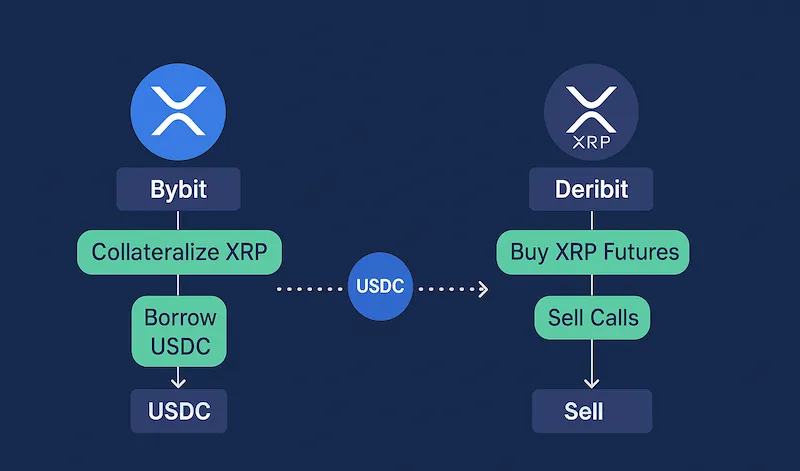
- Collateralize XRP on Bybit – We locked up some of our XRP holdings on Bybit as collateral.
- Borrow USDC – Against that XRP, we borrowed USDC, paying about 11% annual interest.
- Transfer USDC to Deribit – The borrowed USDC was moved to Deribit to serve as option margin.
- Replicate XRP exposure – Since we wanted the trade to mimic a traditional covered call, we bought long XRP perpetual futures on Deribit with 25x leverage.
Effectively, this setup allowed us to hold XRP exposure (via leveraged futures) while still being able to sell call options on Deribit.
Why This Works (and Why It’s Imperfect)
This approach isn’t a perfect covered call structure, but it comes surprisingly close:
- The borrowed USDC plays the role of collateral for selling calls.
- The long XRP futures replicate holding spot XRP, giving us the underlying exposure.
- The sold calls then generate premium just like in a standard covered call strategy.
Of course, there are trade-offs:
- Borrowing USDC at 11% creates a financing cost that eats into returns.
- Using 25x leverage on the long futures introduces liquidation risk if not managed carefully.
- There is ever changing funding fee for holding perpetual futures
- It’s more complex than simply selling calls against spot XRP.
Still, as an experimental structure, it’s a viable workaround until platforms like Bybit start offering XRP options with XRP collateral support.
Looking Ahead
For us, this was a valuable exercise in thinking creatively about option structures in crypto. It’s an experiment we’ll continue to fine-tune, exploring different leverage levels, roll strategies, and ways to minimize financing costs.
The crypto options landscape is evolving quickly. For now, this setup gives us a way to monetize our XRP exposure through covered calls, even if it requires some creative bridging between platforms.
Managing Risk: Rolling Forward and Hedging With Trigger-Based Shorts
| 24 seen
In the past week, one of our ETH option positions came under pressure. We were short 1.7 ETH put contracts with a 4100 strike expiring on August 22. With ETH price action weakening, the trade started to look challenged.
At Terramatris, our primary focus is risk management. Collecting option premium is attractive, but holding onto a position that feels unsafe can quickly turn into a liability. We therefore took a hard look at our choices:
- Roll forward to a later expiry to keep premium income flowing.
- Hedge with futures to neutralize delta risk.
- Combination strategies, blending both approaches.
Why It Felt Unsafe
Near-dated puts carry high gamma risk. If ETH sold off aggressively before expiry, our margin exposure would spike, forcing reactive hedging at poor prices. That is not how we operate. Instead, we prefer to anticipate the risk and structure a plan before the market forces it.
The Strategies on the Table
- Pure Roll Forward
Would maintain income, but keep us exposed to downside if ETH broke below 4100 quickly. - Pure Futures Hedge
Would cleanly offset risk, but at the cost of giving up the premium opportunity. - Partial Roll + Hedge
A balanced approach: extend part of the position for more premium while hedging the rest to protect the book.
Our Decision: Partial Roll Down and Hedge
We chose the partial roll. Specifically, we rolled a portion of the puts forward and down in strike, pushing them out to the following week. This not only maintained the position but also collected additional premium due to the skew in ETH options.
For the remainder, we implemented a trigger-based short futures hedge. This hedge activates if ETH trades into specific downside levels, automatically reducing our exposure without tying up unnecessary capital upfront.
Why This Matters
This hybrid strategy accomplishes three things:
- Preserves Income – We keep harvesting option premium.
- Manages Tail Risk – Futures hedge protects against a sharp downside move.
- Keeps Flexibility – Rolling down improves risk/reward if ETH stabilizes or rebounds.
Key Takeaway
This trade illustrates how we operate at Terramatris: never passive, always adaptive. When a position feels unsafe, we don’t sit still. We evaluate the alternatives, choose the mix that balances reward and risk, and execute decisively.
The result: a position that continues to earn, but with downside risk contained. That’s the essence of our de-worrying strategy — turning a challenged trade into a controlled one.
Selling Covered Calls on Borrowed Bitcoin: Strategic Yield with Asymmetric Risk
| 51 seen
On May 25, 2025, we executed a position that perfectly illustrates a niche but compelling setup in the crypto derivatives space. We:
- Borrowed 0.01 BTC (worth $1,080 at the time),
- Posted 0.54 ETH as collateral (worth $1,350),
- And sold a cash-settled call option on 0.01 BTC with a strike price of $110,000,
- Collecting a premium of $17 with weekly expiry (May 30).
Let’s break down the rationale, benefits, risks, and variations of this strategy — and why, despite its synthetic nature, it can be a valuable tool in Terramatris' option yield strategies.
The Core Strategy
The basic idea is to monetize a borrowed BTC position by selling a cash-settled call option against it. If BTC stays below the strike at expiry, we pocket the premium. If BTC rises above the strike, we owe the difference in cash, not the actual asset — avoiding delivery risk.
Important nuance: This is not a traditional covered call.
We don’t own the BTC — we’ve borrowed it.
That makes it a synthetic covered call, with an embedded liability to return the BTC.
When This Trade Makes Sense
We like this setup when there's no strong expectation of a significant upside rally, but also no urgency to unwind BTC exposure. Here's why:
- Downside is unaffected: If BTC dumps, we simply repay what we borrowed + interest.
- Upside is capped: We sacrifice potential gains above the strike, but in this scenario, we don’t own BTC anyway, so that upside isn’t truly ours to begin with.
- Premium acts as yield: In flat or mildly bearish markets, we earn incremental yield on BTC exposure we don’t even fund directly.
This structure creates asymmetric optionality: we earn in neutral-to-bearish markets, while having limited pain if BTC rips — provided we manage risk proactively.
When This Trade Can Go Wrong
While selling calls against borrowed BTC can be structurally appealing in range-bound or declining markets, the risk profile changes drastically if BTC rallies hard.
If BTC rises above the strike price (e.g., to $120,000 while our strike is $110,000), the option gets exercised and we owe the difference in cash — $100 in this case. That’s manageable. But:
- We don’t own the BTC — we borrowed it.
- We must return 0.01 BTC, now worth $1,200, not the $1,080 it was at entry.
- Plus, we’re paying interest on the BTC loan during the holding period.
Yes, we can roll the option up and forward, but if the rally is fast or continuous, this becomes expensive and hard to sustain.
Roll-forward: The Tactical Adjustment
If BTC approaches or breaches the strike before expiry, we can roll the call forward:
- Buy back the current option (at a loss)
- Sell a new call at a later expiry — potentially at a higher strike
- Capture more premium and defer obligation
This defers loss realization and potentially recovers it over time — a classic theta farming tactic.
Why It’s Not Truly “Covered”
Let’s be precise: a covered call requires that you own the underlying asset (BTC). In our case:
- We borrow BTC — we don’t control it fully
- The debt remains even after the option expires
- If BTC rallies hard, we face repayment risk at high prices
So while the structure resembles a covered call, it’s closer to a short BTC position with a cash-settled call overlay.
Alternative: Borrowing Stablecoins Instead
One arguably cleaner alternative would be:
- Borrow USDC or USDT against ETH or BTC
- Use that to buy BTC outright
- Sell a true covered call against it
This shifts the exposure from a BTC liability to a stable-coin liability, which:
- Makes P&L easier to track
- Lets us own the BTC
- Still gives us access to yield via covered calls
However, this invites another question:
Why not just use margin accounts from brokers or exchanges?
That’s valid — platforms like Binance or Deribit offer margin functionality that accomplishes similar goals, often with tighter integrations and better liquidity.
The Bigger Picture: Crypto Borrowing and DeFi
The broader insight here is that crypto borrowing is a rich, under-explored domain.
It powers:
- Staking and yield farming
- Liquidity provision in DeFi protocols
- Cross-asset hedging
- Capital-efficient options strategies like ours
As Terramatris continues exploring multi-asset, multi-platform yield generation, crypto collateralized borrowing remains one of the most flexible primitives available.
Final Thought
This approach is worth exploring only when upside explosion seems unlikely and there’s room to roll or unwind gradually. While it might look attractive due to its yield component and downside neutrality, the tail risk in a bullish breakout is real and potentially severe.
We include trades like this in our playbook not because they're “safe,” but because they challenge assumptions, expand strategic thinking, and reflect how crypto’s flexibility can be both a tool and a trap — depending on execution and timing.
How to Sell a Synthetic Covered Call on ETH
| 169 seen
At TerraMatris Crypto Hedge Fund, we actively deploy a range of options strategies to generate income and manage directional exposure. Today, I want to share an elegant and capital-efficient technique we’re using: the synthetic covered call—a method that replicates the payoff profile of a traditional covered call, without the need to hold the underlying crypto asset.
What Is a Synthetic Covered Call?
Traditionally, a covered call involves owning a crypto asset (like ETH) and selling a call option against it. This generates premium income while capping upside beyond the strike price. But what if you want to benefit from the same structure without committing capital to the spot position?
The solution is to create a synthetic long position using options and then sell a call against it—thus forming a synthetic covered call.
Trade Breakdown: TerraMatris ETH Position (Initiated May 21, 2025)
Here’s how we executed the trade:
- Bought: 1 ATM ETH long call expiring July 25, 2025 — Paid 327 USDT
- Sold: 1 ATM ETH short put with same expiry and strike — Received 253.1 USDT
- Net Debit for Synthetic Long: 327 - 253.1 = 73.9 USDT
This synthetic long position mimics holding 1 ETH. If ETH rises, the value of the long call increases. If ETH drops, we are effectively long through the short put obligation (we’re willing to “buy” ETH at the strike price).
To generate yield, we layered on a short call:
- Sold: 1 weekly ETH call option expiring May 23, 2025, strike 2600 — Collected 31.2 USDT
This short call generates income just like in a traditional covered call. If ETH trades above 2600 by Friday, we’ll roll or adjust the position. If ETH stays below the strike, we keep the premium.
Ongoing Strategy Until July 25
Our plan is to sell a weekly call option every week until the long position expires on July 25, 2025. This rolling strategy aims to capture between 300–400 USDT in total premium over the life of the trade.
Assuming ETH is below 2500 on July 25, we’ll likely get assigned on the short put—effectively buying 1 ETH. At that point, we plan to add a spot ETH long position via perpetual futures, locking in exposure and continuing premium-selling activity.
Break-Even and Risk Profile
The initial synthetic long cost us only 73.9 USDT, while weekly call premiums will potentially offset most of the cost. Factoring in the expected 300–400 USDT in income from short calls, our break-even price on ETH by expiry is projected to be in the $2,100–2,200 range.
- If ETH rallies strongly: Our gains will be capped at the call strike, but the trade is still profitable.
- If ETH drops: We may end up long ETH at an effective cost far below current market prices.
This gives us a high-probability structure to generate yield, manage risk, and opportunistically accumulate ETH.
Conclusion
The synthetic covered call is a powerful tool in our options playbook—especially useful when capital efficiency and yield generation are priorities. It allows us to simulate long exposure and earn premium income without needing to allocate full capital to spot ETH.
At TerraMatris, we continue to explore such strategic derivatives plays to balance income, risk, and long-term crypto accumulation.