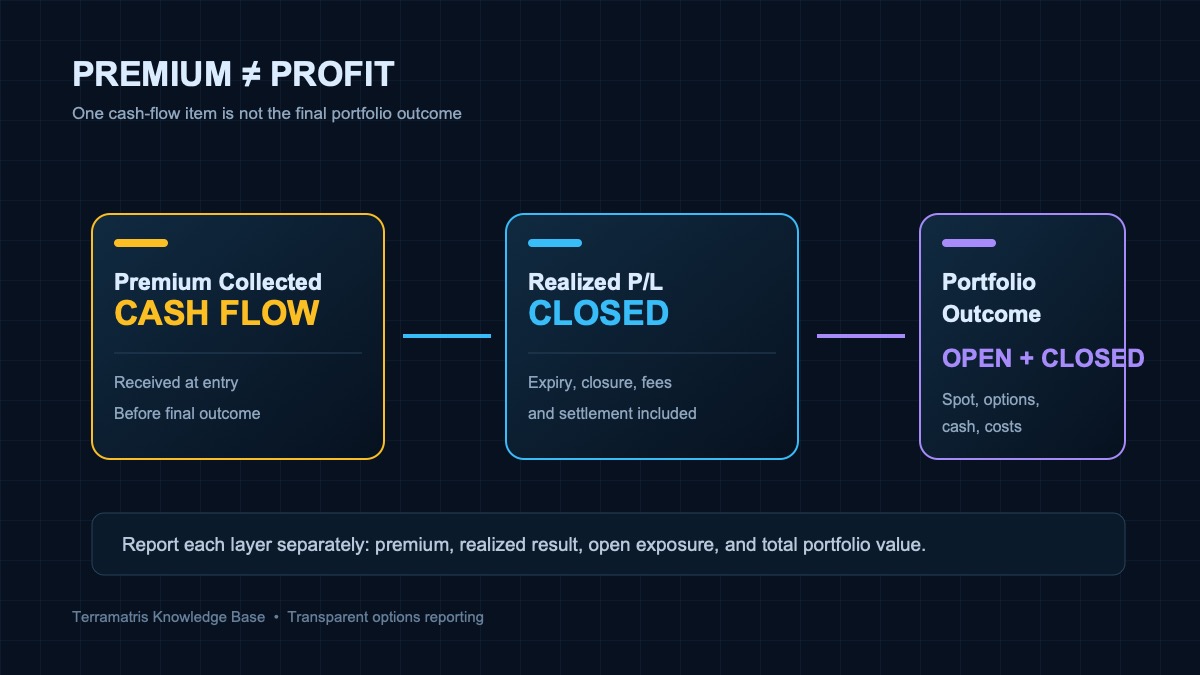
An option seller may receive premium when a position opens. That cash receipt is real. It is not, by itself, the final economic result of the position—or of a broader strategy.
Terramatris publishes educational research and strategy notes on digital-asset options. It does not accept deposits, manage third-party capital, or trade on behalf of investors. (About Terramatris) This article explains a reporting framework for reading options activity clearly. It is educational only, not investment advice, a performance claim, or a forecast.
The core distinction: cash received is not a completed outcome
Premium can arrive before important outcomes are known. A short put may be assigned after the premium is received. A covered call may limit participation in a later rally. An open option can change in value before it expires or is closed. Fees, funding, interest, settlement costs, slippage, taxes, and foreign-exchange treatment may also affect the eventual economic result.
A roll can be particularly easy to misread: it may generate a credit while extending exposure and creating a new obligation. For that reason, “premium collected” should not be presented as synonymous with “profit,” “return,” or “NAV change.”
Four figures that should stay separate
1. Gross premium collected
Gross premium collected is the option premium received during a reporting period before the report’s stated treatment of fees, funding, and later position outcomes. It describes option-related cash flow. On its own, it does not establish a return, a change in net asset value, or a final P&L result.
2. Realized trading P&L
Realized trading P&L is the economic result of closed positions under a documented accounting policy. A useful policy states whether it includes entry and exit fees, funding, interest, settlement costs, foreign-exchange conversion, and the realized gain or loss from an assigned asset when that asset is later sold.
The important qualifier is closed. If a trade has created an asset position that remains open, the full strategy outcome may still be unresolved.
3. Unrealized P&L
Unrealized P&L is the mark-to-market movement of open positions. Its interpretation depends on the valuation source and timestamp used in the report. It can change before the next report and should not be silently blended into realized performance.
4. Net portfolio value or NAV change
Net portfolio value reflects the change in total portfolio value under a documented valuation method. Depending on the strategy, it can include spot assets, open options, cash, debt, and other holdings. It can therefore differ materially from options premium collected.
Educational example: a cash-secured ETH put
The following is a hypothetical accounting example, not a Terramatris trade, recommendation, or performance result.
Suppose a cash-secured ETH put is sold for 20 units of stablecoin.
- At entry: gross premium collected is 20 units.
- If the option expires worthless and fees are 2 units: realized trading P&L may be 18 units under the stated policy.
- If the put is assigned: the 20-unit premium may lower the effective purchase cost, but the trader now owns ETH. The strategy’s eventual result remains open until the subsequent exposure is accounted for.
- If ETH later declines: the portfolio can show an unrealized loss despite the premium having been collected.
- If a covered call is then sold: that additional premium is another cash-flow item. It does not, by itself, demonstrate that the earlier assignment was economically successful.
The lesson is not that premium is unimportant. Premium is one component in a sequence of positions, obligations, costs, and valuations.
What a transparent weekly report should show
A clear report makes the status and definition of each figure visible.
| Reporting field | What it helps readers understand |
|---|---|
| Gross premium collected | Option cash flow without treating it as final profit. |
| Realized closed-position P&L | Completed economic results under a stated accounting policy. |
| Fees, funding, and interest | The costs included in or excluded from reported figures. |
| Unrealized P&L | Open-position exposure without presenting it as final. |
| Cash, collateral, and debt | Capacity, financing, and liquidity considerations. |
| Open options and assignment exposure | Obligations that may affect later outcomes. |
| Benchmark and drawdown | Context, provided the comparison method is defined in advance. |
Terramatris’s performance index publishes recurring fields for options premium, fund value, YTD, cash, and TerraM price. (Weekly Performance) Readers should consult the dated underlying report for any stated historical value, price, return, premium, NAV, or strategy event. (Weekly Performance) (Episode 159)
Why definitions and reconciliation matter
Separating premium, realized P&L, unrealized P&L, and portfolio value helps prevent common reporting errors:
- annualizing a short period of premium as if risk and market conditions were constant;
- treating a roll credit as a resolved profit or loss;
- ignoring the later movement of an assigned asset;
- comparing a portfolio with a benchmark without defining cash, debt, fees, valuation time, or methodology; and
- using premium as a proxy for liquidity, token value, or holder entitlement.
For Terramatris communications, TerraM should not be represented as equity, debt, a fund share, a claim on assets, or a source of ownership, redemption, governance, or profit-distribution rights. (TerraM information and risks) TerraM price is not NAV and does not create an entitlement to underlying assets. (TerraM information and risks)
A publication standard for performance figures
Before publishing a number, a report should be able to answer these questions:
- What exactly does the figure measure?
- Which transactions and costs does it include or exclude?
- What reporting date, valuation source, and timestamp apply?
- Is the figure realized, unrealized, historical, a target, or a hypothetical scenario?
- Can a correction be versioned rather than silently overwriting the earlier record?
When an accounting method has not been approved or the underlying data is unavailable, the appropriate disclosure is Not available, with a brief explanation. Missing data should not be replaced with an estimate presented as fact.
Risk and limitations
Options strategies involve risks that can extend beyond the premium received. Assignment can create spot exposure. Covered calls can cap gains during a rally. Open positions can move sharply in value. Costs and valuation methods can change the interpretation of a reported result.
Historical, self-reported strategy figures are not forecasts. Terramatris’s published materials are educational and informational, and no statement in this article is a guarantee of a return, yield, profit, token value, liquidity, or holder right. (TerraM information and risks) (About Terramatris)
Related Terramatris research
Continue with these first-party resources:
- Weekly performance index — dated reports and recurring performance fields: Terramatris Performance.
- Ethereum strategy research — published framework for cash-secured puts, covered calls, and the Ethereum options process: Ethereum Strategy.
- Ethereum wheel strategy guide — a practical walkthrough of cash-secured puts, assignment, covered calls, and rolling decisions: Ethereum Wheel Strategy.
- 1-DTE ETH options bot controls — a research framework for documented automation, stop conditions, and human review: 1-DTE ETH Options Bot: Rules, Guardrails and Risks.
- Strategy research overview — Terramatris’s current strategy-research positioning: Strategies.
- TerraM information and risks — current token disclosures and risk framing: TerraM.
- Terramatris background and disclosures — organization and educational-research positioning: About Terramatris.