A Bitcoin covered call exchanges some future BTC upside for a premium received today. It can be a deliberate overlay when an investor is genuinely willing to sell Bitcoin at the strike, but it is not equivalent to holding Bitcoin and it is not a substitute for risk control.
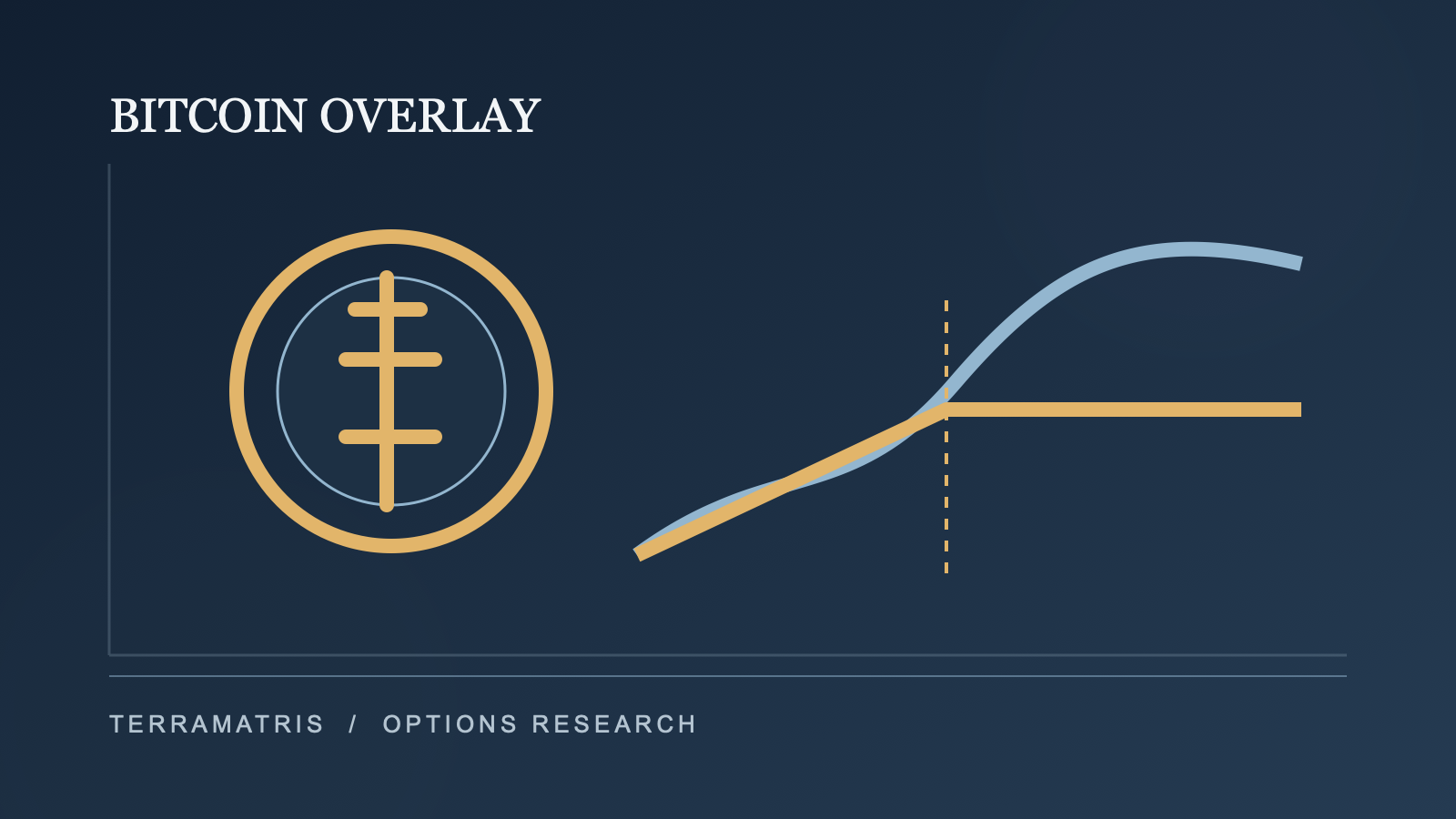
Terramatris treats an options overlay as a portfolio decision rather than a yield product. The relevant comparison is not premium alone; it is the resulting net asset value, the BTC exposure retained, the assignment outcome and the return that would have occurred without the call.
What is a Bitcoin covered call?
A covered call combines a long Bitcoin position with a short call written against an amount of BTC that can actually be delivered or settled. The call buyer receives the right to benefit above a defined strike at expiry; the writer receives premium and accepts the obligation. “Covered” describes the collateral relationship. It does not mean the Bitcoin position cannot lose value.
For example, assume 1 BTC is worth $80,000. A portfolio sells a one-month $92,000 call for $1,500. If BTC expires below $92,000, the call may expire without value and the portfolio retains the BTC plus the premium before fees. If BTC closes above $92,000, the upside above the strike belongs to the call buyer. A large rally can therefore leave the covered-call portfolio behind a simple BTC holding.
The comparison that matters: total outcome, not premium yield
A premium quote is a cash inflow. It is not a complete return calculation. A sensible comparison starts with the same BTC quantity and the same valuation timestamp, then records premium received, option mark-to-market, fees, collateral costs, realized settlement and the BTC price movement. The outcome should be compared with a no-overlay BTC benchmark over the same dates.
This is why Terramatris separates options premium from profit. A call can produce premium while the BTC position declines; a call can also show premium while a rally creates a large opportunity cost. Neither result is explained by annualizing one week of premium.
When a covered call can fit the stated objective
The strategy can fit a holder who has already defined a sale level, accepts assignment, and prefers some current premium to unlimited upside over the option’s life. It may also be used for only part of a BTC allocation, leaving the remainder uncovered. The decision is strongest when the strike, expiry and assignment response are set before the premium is received.
- The underlying BTC amount is owned or otherwise fully collateralized under the venue’s rules.
- The strike is a level at which selling BTC would be acceptable even if the market later rises further.
- The position size leaves room for adverse moves, settlement mechanics and any currency mismatch.
- The portfolio has a written response for expiry, assignment, buyback and roll decisions.
When holding Bitcoin is the cleaner choice
Buy-and-hold retains all upside and all downside. It has no short-option assignment obligation and no need to decide whether to roll a call during a rapid rally. For a holder whose main objective is uncapped participation in Bitcoin’s upside, selling calls can conflict with the actual thesis. Premium is not compensation for a plan the portfolio did not want to execute.
The important question is therefore not “what yield is available?” but “would this portfolio still be satisfied with the outcome if BTC finishes well above the strike?” If the answer is no, the call is likely solving the wrong problem.
Assignment, rolling and liquidity
Assignment should be treated as a planned state, not a surprise. A roll closes or offsets one obligation and opens another; it can add time, change the strike, consume liquidity and turn an accepted sale decision into a new directional position. A roll is not automatically prudent merely because it creates another credit.
Venue terms matter. Crypto options may use cash settlement, physical delivery, different collateral currencies, exchange marks and different exercise procedures. Wide spreads or thin open interest can make a theoretical premium difficult to realize. Terramatris’ Bitcoin Strategy records methodology and risk context separately from a generic payoff diagram.
A practical measurement template
For each cycle, record the starting BTC quantity and price, strike, expiry, premium, commissions, collateral currency, option mark, final settlement and ending BTC quantity. Then compare the overlay NAV with the same BTC amount held without the option. The comparison should include downside as well as upside and should not treat a favorable expiry as proof that the next cycle has the same risk.
This benchmark discipline connects with how to benchmark a crypto options-income strategy. It also helps prevent a portfolio from confusing a sequence of small credits with a superior long-run result.
Bottom line
Bitcoin covered calls can be a useful overlay for a defined sale objective, not a promise of passive income. The premium is real cash flow, but the short call creates a real obligation and caps upside above the strike. Readers comparing strategies can review Start Here, the strategy overview and the published performance history before drawing conclusions from any single option cycle.
This article documents a research framework, not a recommendation or a promise of income. Options can create obligations, losses, assignment risk, liquidity risk and counterparty risk. Any implementation needs its own collateral, venue and position-size controls.
Questions to answer before selling a BTC call
First, identify the BTC amount that can genuinely be sold. A portfolio can decide that only a fraction of a long-term holding is available for an overlay, leaving the remainder unencumbered. Second, specify whether the strike is a target sale price or only a number selected because it produced an attractive premium. Those are different decisions.
Third, document the comparison period. A call that expires without value during one quiet month does not answer how the overlay behaves across a rapid rally, sell-off and volatility shock. Review realized settlement alongside the BTC that remains, any BTC delivered and the opportunity cost relative to the matched spot holding.
Frequently asked questions
Is a BTC covered call safer than Bitcoin?
It remains exposed to Bitcoin downside and sacrifices upside above the strike. Its risk profile differs from spot; it is not simply a lower-risk version of spot.
Does assignment mean the strategy failed?
No. Assignment can be a planned sale outcome. It is a problem only when the portfolio wrote a call at a price it was not actually willing to accept.
Can the premium make a large rally irrelevant?
No. The premium shifts the result modestly, while the short call limits participation above the strike. The full comparison must use ending NAV and BTC quantity.
A reader’s evidence checklist
Before treating an options strategy as useful, identify the exact underlying, contract size, strike, expiry, settlement terms and collateral. Then ask which figures are observed, which are estimated and which are unavailable. A strategy description that names only premium but not the obligation, open exposure or valuation method leaves the most important risk questions unanswered.
Review a sequence rather than a single favorable expiry. The useful record shows the starting allocation, the decision rule, changes to the position, fees, assignment or settlement, ending NAV and a comparable alternative. It should also identify where the record cannot support attribution. That discipline is especially important in crypto, where liquidity, venue rules and collateral values can change quickly.
Terramatris publishes research and historical strategy documentation so readers can inspect definitions and limitations. The appropriate next step is to compare the methodology with the relevant strategy pages and performance records, not to treat this educational framework as a trade instruction.