An options-income strategy can lag spot when its short calls cap upside, its hedge costs rise, or its position is structured for a range-bound market while the underlying makes a large directional move. Premium received is compensation for an obligation; it does not preserve every dollar of upside.
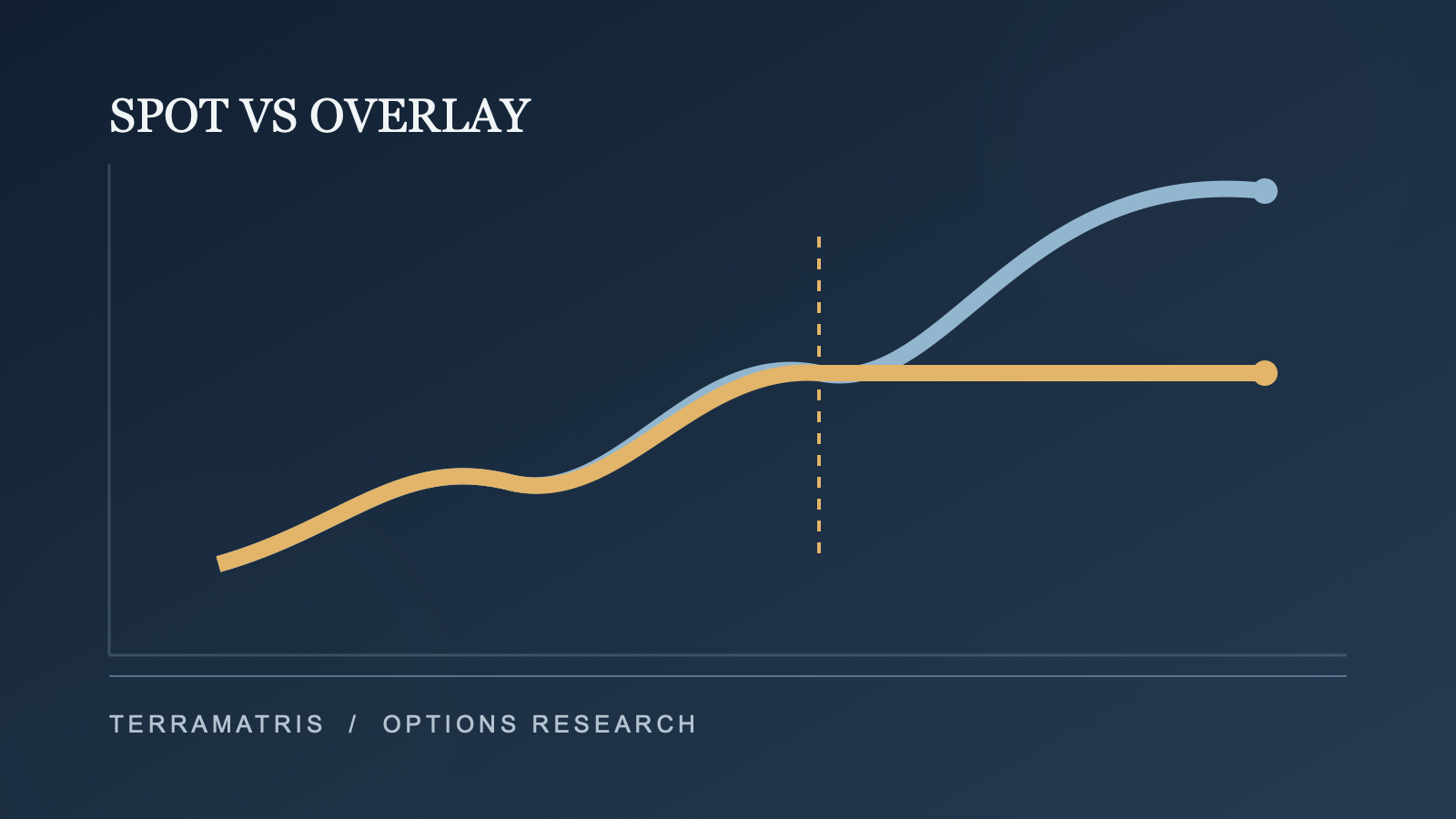
This is not a defect that can be solved by annualizing premiums. It is the core trade-off. A portfolio selling calls on BTC or ETH has deliberately exchanged some convex upside for immediate cash flow. The right question is whether that trade-off matches the strategy’s stated objective and benchmark.
The covered-call payoff explains the lag
A covered call owns the underlying and sells a call at a strike. Below the strike, the underlying moves broadly like spot, offset by the premium and option value. Above the strike near expiry, the call increasingly offsets gains in the underlying. The portfolio may still have a positive return, but it can earn materially less than a spot-only benchmark in a sharp rally.
For example, if ETH is $3,000 and a portfolio sells a $3,300 call for $100, a move to $4,000 can leave the portfolio with premium plus gains only to the effective sale level. A spot holder participates through $4,000. The $100 premium is not a substitute for the upside above $3,300.
Short options are not the same as a portfolio return
A strategy may report premium collected, realized option P/L, open option mark, underlying P/L, fees and total NAV. Those figures answer different questions. The distinction is covered in Options Premium Is Not Profit: a premium inflow can coexist with an unrealized loss, an assignment cost or an opportunity cost relative to spot.
Comparisons should use the same starting capital, dates, underlying quantity and valuation methodology. A premium-only series can look smooth while the actual NAV has large exposure to underlying price moves.
Market regimes matter
Options overlays tend to be path dependent. In a quiet or gradually rising market, a call may expire without value and premium can provide a modest cushion. In a fast rally, the call may become deeply in the money and cap gains. In a sell-off, the premium can soften but usually does not eliminate the underlying loss. In a volatile whipsaw, repeated rolling can add transaction costs and decision risk.
No regime label guarantees an outcome. Implied volatility may be high because the market expects large moves, and selling elevated premium means accepting the risk those prices imply. A strategy should not infer safety from high premium alone.
Why rolling is not a free repair
When a short call is threatened by a rally, a portfolio can accept assignment, buy it back, or roll to a later expiry and perhaps a higher strike. Each choice changes the exposure. Buying back gives up prior premium and may crystallize a loss. A roll may retain the position but adds time and can leave the portfolio short upside during a continued rally. Assignment may be clean if it was planned.
A decision rule written before entry is more credible than a roll chosen because the earlier strike now feels uncomfortable. That is why the Ethereum Wheel Strategy guide treats assignment as one of the planned outcomes rather than an error condition.
How to judge the trade-off
A useful review asks: What percentage of the underlying was overwritten? What strike and expiry were selected? What was the premium relative to the capital at risk? What was the spot benchmark return? Did the portfolio accept or avoid assignment? What did fees and buybacks cost? These questions create an evidence trail rather than a yield narrative.
A partial overlay may preserve more upside than writing calls on the whole position, while a full overlay may create a clearer income objective but a larger cap. Neither is universally better; the allocation has to fit the portfolio’s stated risk budget.
Terramatris context
Terramatris documents strategies and weekly records so that readers can distinguish process from outcome. The performance history is more informative than a single premium claim, and the Bitcoin Strategy and Ethereum Strategy pages explain that an options overlay is only one component of portfolio construction.
Readers who want to compare spot with an overlay should also read Bitcoin Covered Calls vs Holding Bitcoin and how to benchmark an options-income strategy.
Bottom line
An options-income strategy can underperform spot during a rally because capped upside is the price of the premium received. A fair evaluation records the full NAV, assignment decisions, open exposure and a matched spot benchmark. It should not turn a small, realized premium into a claim about the portfolio’s total economic result.
This article documents a research framework, not a recommendation or a promise of income. Options can create obligations, losses, assignment risk, liquidity risk and counterparty risk. Any implementation needs its own collateral, venue and position-size controls.
Use relative return, not a slogan
Relative return is the overlay NAV return minus the matched spot return over the same period. That number can be negative even when the overlay earns an absolute gain. Reporting both figures avoids the false choice between calling a strategy successful because it made money and calling it unsuccessful because it lagged spot; the two observations can both be true.
A strategy can choose to accept that trade-off if its mandate values reduced upside participation, planned sales or a different cash-flow profile. The important requirement is that the mandate be stated before the rally, rather than rewritten after the fact.
Frequently asked questions
Do high premiums solve the capped-upside problem?
They may change the trade-off but do not remove it. High implied volatility can also signal a greater likelihood of large moves.
Does a call always underperform in a rally?
It depends on strike, expiry, premium and path. The main point is that upside above the effective sale level is no longer fully retained.
Should every call be rolled higher?
No. A roll is a new risk decision. Compare its cost, new strike, remaining exposure and assignment objective with accepting the original outcome.
A reader’s evidence checklist
Before treating an options strategy as useful, identify the exact underlying, contract size, strike, expiry, settlement terms and collateral. Then ask which figures are observed, which are estimated and which are unavailable. A strategy description that names only premium but not the obligation, open exposure or valuation method leaves the most important risk questions unanswered.
Review a sequence rather than a single favorable expiry. The useful record shows the starting allocation, the decision rule, changes to the position, fees, assignment or settlement, ending NAV and a comparable alternative. It should also identify where the record cannot support attribution. That discipline is especially important in crypto, where liquidity, venue rules and collateral values can change quickly.
Terramatris publishes research and historical strategy documentation so readers can inspect definitions and limitations. The appropriate next step is to compare the methodology with the relevant strategy pages and performance records, not to treat this educational framework as a trade instruction.